Doctor of Philosophy in Biostatistics
PhD in Biostatistics
Visit the course catalogue for additional information
Program Overview
Our Ph.D. program has been designed to provide rigorous training in statistical theory and methods, with the goal of enabling students to carry out original research in biostatistics. Graduates of our Ph.D. program are prepared to:
- Conduct theoretical and methodological research in biostatistics.
- Employ modern statistical techniques in the analysis of large and/or complex data sets in the health sciences.
- Serve as biostatisticians in collaborative research teams in the health sciences.
- Teach biostatistics to health sciences professionals and graduate biostatistics students.
We seek students with bachelor's or master’s degrees in mathematics, statistics, biostatistics, or related fields who are interested in extending their knowledge of biostatistics to be able to conduct cutting-edge research in theory and methodology. The Ph.D. curriculum is mathematically rigorous, so while we do welcome individuals with diverse backgrounds to our program, applicants are required to possess some level of fluency in advanced mathematics.
The Ph.D. curriculum involves 34 hours of coursework (56 hours if entering with a Bachelor's degree), including a practicum course in which students engage in biostatistical consulting. Comprehensive examinations are taken after successful completion of core courses. Students emphasizing in biostatistics move on to take courses in clinical trials, generalized linear models, survival analysis and other biostatistical electives. Students emphasizing in bioinformatics take courses in high-throughput computing, statistical genetics, bioinformatics, and other electives in biostatistics and genetics. Upon completion of the 34 hours of course work (or 56 hours if entering with a Bachelor's degree), students enter doctoral candidacy, during which dissertation research is conducted. All students are required to complete and defend a dissertation prior to graduation.
We encourage you to take a detailed look at the Ph.D. curriculum, information on the comprehensive exams, and requirements for the doctoral dissertation to get familiar with the Ph.D. degree.
If you are interested in applying to the Ph.D. program, be sure to review our admission requirements. Feel free to contact us if you have any questions about our Ph.D. program.
Comprehensive Exams
After completion of required coursework, Ph.D. students take a comprehensive examination which tests foundational knowledge in statistical theory and methodology. The examination is given over two days in late July or early August, covering material in the core courses of the Ph.D. program - statistical inference (PHST 762), linear models (PHST 781), statistical computing (PHST 710), and Bayesian statistics (PHST 691).
The exam is given in two components, one written and one computing. Questions on the exam can draw from each of the core PhD courses but are organized into blocks corresponding to the core course under which each question primarily falls. Material from each of the core courses will help students prepare for those sections. Links to comprehensive exams from prior years are provided below which can also be useful for exam preparation.
Each student receives a grade of either "pass" or "fail" for the examination. Students that pass will be eligible to enter doctoral candidacy upon completion of the remaining coursework. Students that fail will have one opportunity to retake the comprehensive examination, typically in December or January immediately following the initial attempt at the exam. Students that fail on their second attempt will be dismissed from the program without further consideration.
For more information about the Comprehensive Exams or to get access to old exams, contact us

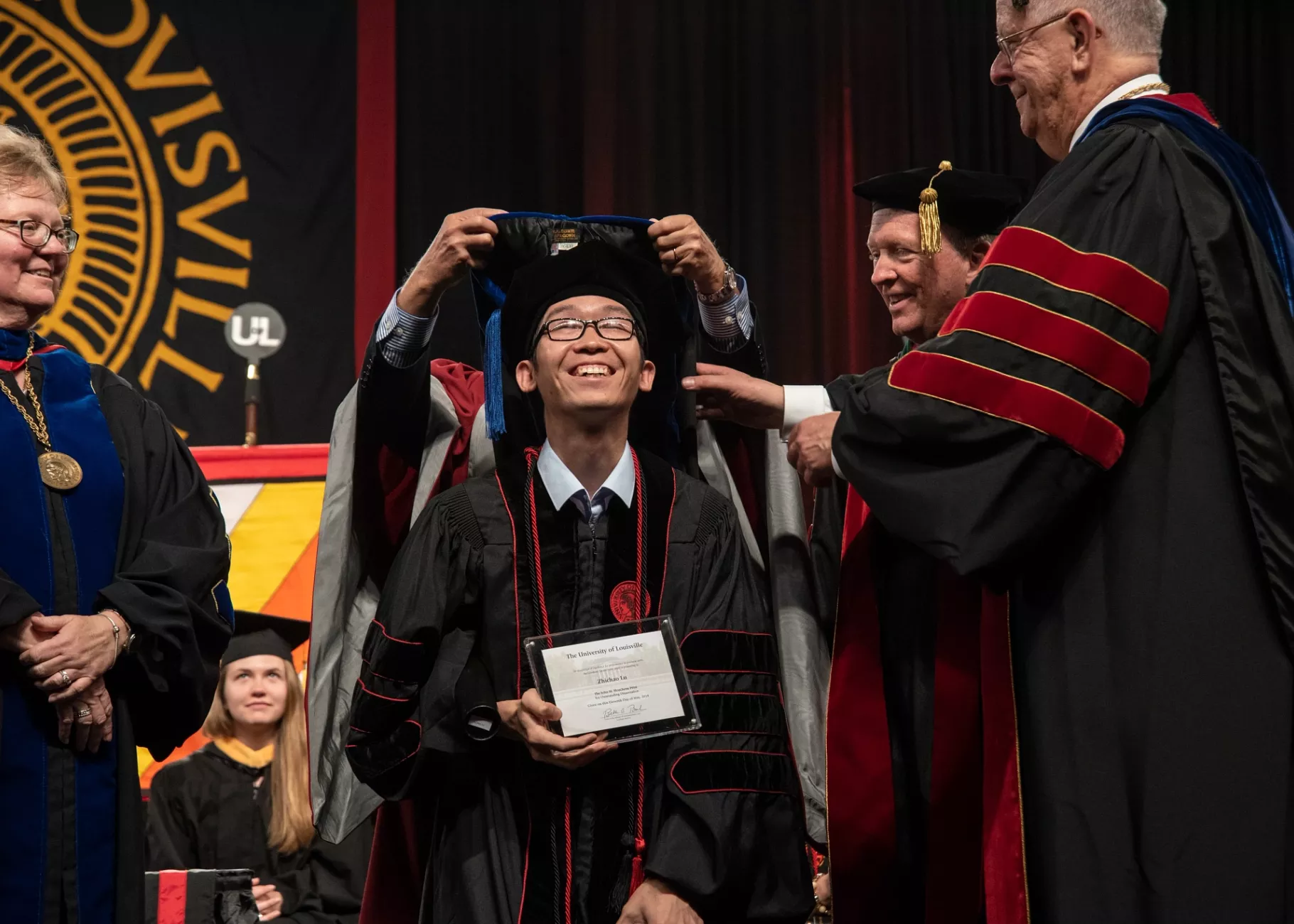
I couldn’t have asked for a better group of professors to guide me through my doctoral studies. They are truly passionate about biostatistics and desire to inspire others. I cannot express how grateful I am for experiencing such an amazing journey. SPHIS shaped both my academic and professional career. Choosing SPHIS to follow my doctoral education was one of the best choices I ever made in my life.

Additional Information
Comprehensive Exams
Prior to the second year of study, Ph.D. students take a comprehensive examination which tests foundational knowledge in statistical theory and methodology. The examination is given over two days in August, shortly before the start of the second year of study, covering material in the core courses of the Ph.D. program - statistical inference (PHST 762), linear models (PHST 781), statistical computing (PHST 710), and Bayesian statistics (PHST 691).
The exam is given in two components, one written and one computing. Questions on the exam can draw from each of the core PhD courses, but are organized into blocks corresponding to the core course under which each question primarily falls under. Material from each of the core courses will help students prepare for those sections. Links to comprehensive exams from prior years are provided below which can also be useful for exam preparation.
Each student receives a grade of either "pass" or "fail" for the examination. Students that pass will be eligible to enter doctoral candidacy upon completion of the remaining, second-year coursework. Students that fail will have one opportunity to retake the comprehensive examination, typically in December or January immediately following the initial attempt at the exam. Students that fail on their second attempt will be dismissed from the program without further consideration.
For further details on the comprehensive exams, consult the full Ph.D. curriculum for additional details.
Send an e-mail to Lisa Bell, Program Coordinator to request access to previous comprehensive exams.
Contact